
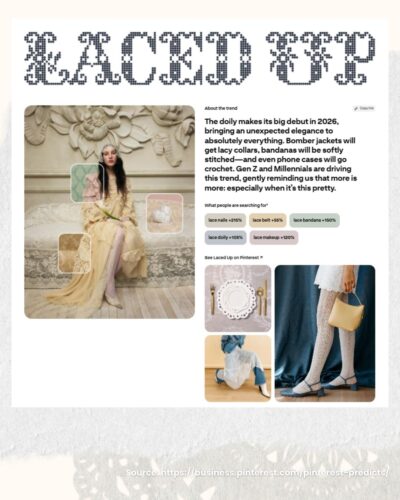
When Pinterest released its 2026 trend predictions, lace seemed like one of the safer bets. Unlike some of the platform’s more surprising forecasts—Opera Aesthetic, Brooched, or the resurgence of heirloom-inspired styling—lace has never truly disappeared from fashion. It reappears every few years in different forms, moving from bridal collections to streetwear, from luxury runways to vintage-inspired wardrobes.
Yet what has unfolded throughout 2026 has been more interesting than a simple revival of lace.
The trend hasn’t been about delicate dresses or formal occasions. Instead, lace has become part of a much larger cultural movement that could be described as the return to girlhood. Across fashion, beauty, home décor, accessories, and even technology, women have embraced overtly feminine details with a sense of playfulness that feels both nostalgic and surprisingly modern.
Lace has shown up everywhere this year, but rarely where you’d expect it. It’s appeared layered under oversized jackets. Trimmed along socks paired with chunky sneakers. Wrapped around handbags. Added to baseball caps. Incorporated into phone charms, laptop accessories, and even gaming setups. Bows, ribbons, frills, and lace have escaped traditional fashion categories and begun appearing in spaces that were once considered aggressively practical or gender-neutral.
The result is a trend that says something much bigger than “lace is back.” It suggests that women are redefining femininity on their own terms.
The Unexpected Rise of Girlhood Aesthetics
One of the most interesting visual shifts of the past few years has been the rise of what many creators call “girlhood aesthetics.” The term doesn’t refer to childishness or immaturity. Instead, it reflects a willingness to embrace joy, sentimentality, softness, nostalgia, and traditionally feminine design elements without apology.
For years, much of modern branding pushed women toward a particular version of empowerment that often looked remarkably masculine. Success was communicated through sharp tailoring, neutral colors, minimalism, and an almost corporate seriousness.
Somewhere along the way, femininity itself became suspect. Pink was considered frivolous. Bows felt juvenile. Frills seemed unserious. Lace was often dismissed as overly romantic or outdated. Today’s consumers appear less interested in those rules.
Instead, many women are reclaiming these visual cues simply because they enjoy them. That’s why we’re seeing lace appear alongside other nostalgic influences like charm bracelets, ribbon details, scrapbook aesthetics, vintage stickers, diary-inspired journaling, dollhouse interiors, and even the revival of Polly Pocket-inspired accessories and tech décor.
Yes, people are decorating their laptops now. Their keyboards. Their phone cases. Their gaming setups. Their water bottles. And increasingly, they’re doing it with unapologetically feminine details.
The Polly Pocket Effect
Perhaps no symbol captures this trend better than the unexpected return of Polly Pocket-inspired design language. Tiny charms. Miniature worlds. Compact treasures. Bright colors. Decorative details. What was once considered a children’s toy aesthetic has become a source of inspiration for adult consumers seeking playfulness in everyday life.
The influence extends far beyond fashion. Technology accessories have become particularly interesting examples. Keyboards decorated with ribbons. Laptop covers adorned with lace stickers. Phone cases layered with charms. Tablet accessories customized with bows and pearls. Headphones wrapped in ribbons. Desk setups that look more like elaborate dollhouses than workstations.
In previous years, many consumers sought sleek, minimalist tech products that blended into the background. Today, many women want the opposite. They want objects that reflect personality. Lace fits naturally into this movement because it immediately communicates softness, creativity, and individuality. A strip of lace can transform an ordinary object into something that feels uniquely personal.
Why Feminine Doesn’t Mean Passive
One of the reasons this trend is so culturally interesting is that it arrives during an ongoing conversation about femininity itself. Historically, overtly feminine aesthetics have often been treated as less serious, less powerful, or less intelligent than their masculine counterparts. Many women learned that to be taken seriously, they needed to distance themselves from traditionally feminine interests. The return of lace suggests a rejection of that idea.
The women embracing these aesthetics aren’t necessarily looking backward. They’re making a statement that femininity and competence are not opposites. A founder can run a company while carrying a bow-covered handbag. A designer can create groundbreaking work while wearing lace-trimmed socks. A gamer can customize a mechanical keyboard with ribbons and still dominate a leaderboard. A business owner can decorate her workspace like a dollhouse and still negotiate contracts.
The point isn’t the lace itself. The point is the freedom to choose it.
Not Quite Trad Wife, Not Quite Pilates Princess
Because this trend embraces traditional feminine imagery, it’s easy to confuse it with other aesthetics that have gained attention online. But there are important distinctions.
The modern lace movement tends to be centered on self-expression rather than prescription. Many women engaging with lace, bows, and girlhood aesthetics are not attempting to recreate historical gender roles. Nor are they necessarily pursuing highly curated luxury lifestyles. Instead, they’re treating femininity as a creative medium.
This differs from some interpretations of “trad wife” content, which often focuses on idealized domestic roles and presents a specific vision of womanhood as aspirational. It also differs from the “Pilates Princess” aesthetic, which can sometimes emphasize a narrow set of beauty standards, wellness routines, and luxury consumption habits.
The lace trend feels broader. More democratic. More playful. You don’t need a designer wardrobe. You don’t need a luxury gym membership. You don’t need a perfect kitchen or a picture-perfect morning routine. You just need permission to enjoy things that feel beautiful. That distinction matters because it shifts femininity from performance to personal expression.
Feminine Branding Is Having a Moment
Interestingly, some of the strongest examples of this trend aren’t coming from fashion brands at all. Many female-focused brands have begun embracing softer visual languages in ways that would have felt unlikely a decade ago. Women’s wellness brands increasingly incorporate hand-drawn illustrations, ribbons, florals, and romantic design details.
Independent bookstores aimed at female audiences often lean into vintage-inspired typography and delicate visual elements. Female-founded beauty brands frequently blend nostalgia, whimsy, and softness with messages of confidence and self-determination.
Even brands centered around entrepreneurship, leadership, and career development have started moving away from ultra-corporate visual identities. Instead of black-and-white minimalism, they’re incorporating warmer colors, decorative details, and visual cues traditionally associated with femininity.
What’s remarkable is that these brands aren’t abandoning empowerment. They’re expanding what empowerment can look like. The message is no longer “you can succeed despite your femininity.” It’s increasingly becoming “you can succeed while embracing it.”
What This Means for Retail Brands
For retailers, the lace trend offers valuable lessons that extend far beyond fashion. Consumers are increasingly responding to products that feel personal, expressive, and emotionally resonant. Lace works because it adds texture.
It creates visual interest. It introduces softness into otherwise ordinary objects. Most importantly, it helps products feel styled rather than manufactured.
A clothing boutique can incorporate lace details into photography without becoming overly romantic. A stationery brand can use lace-inspired textures to create visual warmth. A skincare company can soften product imagery through layered fabrics and handcrafted details. Even brands that don’t sell traditionally feminine products can borrow elements of the trend by emphasizing texture, storytelling, and personalization.
The key isn’t copying the aesthetic directly. It’s understanding why consumers are responding to it.
Why Lace Performs So Well on Social Media
From a marketing perspective, lace is practically engineered for visual storytelling. Social media platforms reward texture. They reward detail. They reward imagery that invites viewers to linger. Lace creates all three.
Its patterns create depth. Its transparency creates contrast. Its handmade appearance suggests craftsmanship. In an endless stream of polished content, lace introduces visual complexity that feels organic rather than manufactured.
It also photographs beautifully. Whether layered into flat lays, woven into product styling, or incorporated into lifestyle imagery, lace adds movement and softness without overwhelming the subject. For brands competing for attention, these subtle details can make a significant difference.
More Than a Fabric
Halfway through 2026, it’s clear that Pinterest’s lace prediction wasn’t really about fabric. It was about permission. Permission to be playful. Permission to embrace nostalgia. Permission to decorate the practical parts of life. Permission to enjoy beauty without needing to justify it.
The return of lace reflects a broader cultural shift in how women are engaging with femininity. Rather than rejecting feminine aesthetics in pursuit of credibility, many are choosing to redefine those aesthetics altogether. They’re taking symbols that were once dismissed as superficial and transforming them into tools for self-expression.
That’s why lace has appeared everywhere this year—from fashion runways to keyboard setups, from handbags to branding campaigns. Not because consumers suddenly became obsessed with Victorian romance. But because they became less interested in pretending they weren’t.
For retailers, marketers, and brands paying attention to visual culture, that’s the real story behind the trend. Lace may be the material. Girlhood is the movement. And neither seems to be disappearing anytime soon.
Understand Shopping Trends
We’re dropping our next newsletter in December 2026. Sign up for exclusive freebies, giveaways, and industry insights.